Public AI and Europe’s Digital Sovereignty
On 13 January 2026, we co-organized a lunch event on Public AI and digital sovereignty at the European Parliament in Brussels. MEPs Michał Kobosko (Renew) and Sergey Lagodinsky (Greens) co-hosted with Bertelsmann Stiftung, Mozilla Foundation, Democratic Tech Alliance, and Open Future. The event gathered policymakers, researchers, and civil society to discuss how Europe can develop public AI systems, ensuring competition and sovereignty.
The parliamentary event was an opportunity to launch our latest policy brief on “European Public AI”, commissioned by Bertelsmann Stiftung through reframe[Tech] – Algorithms for the Common Good and authored by Alek Tarkowski and Felix Sieker.
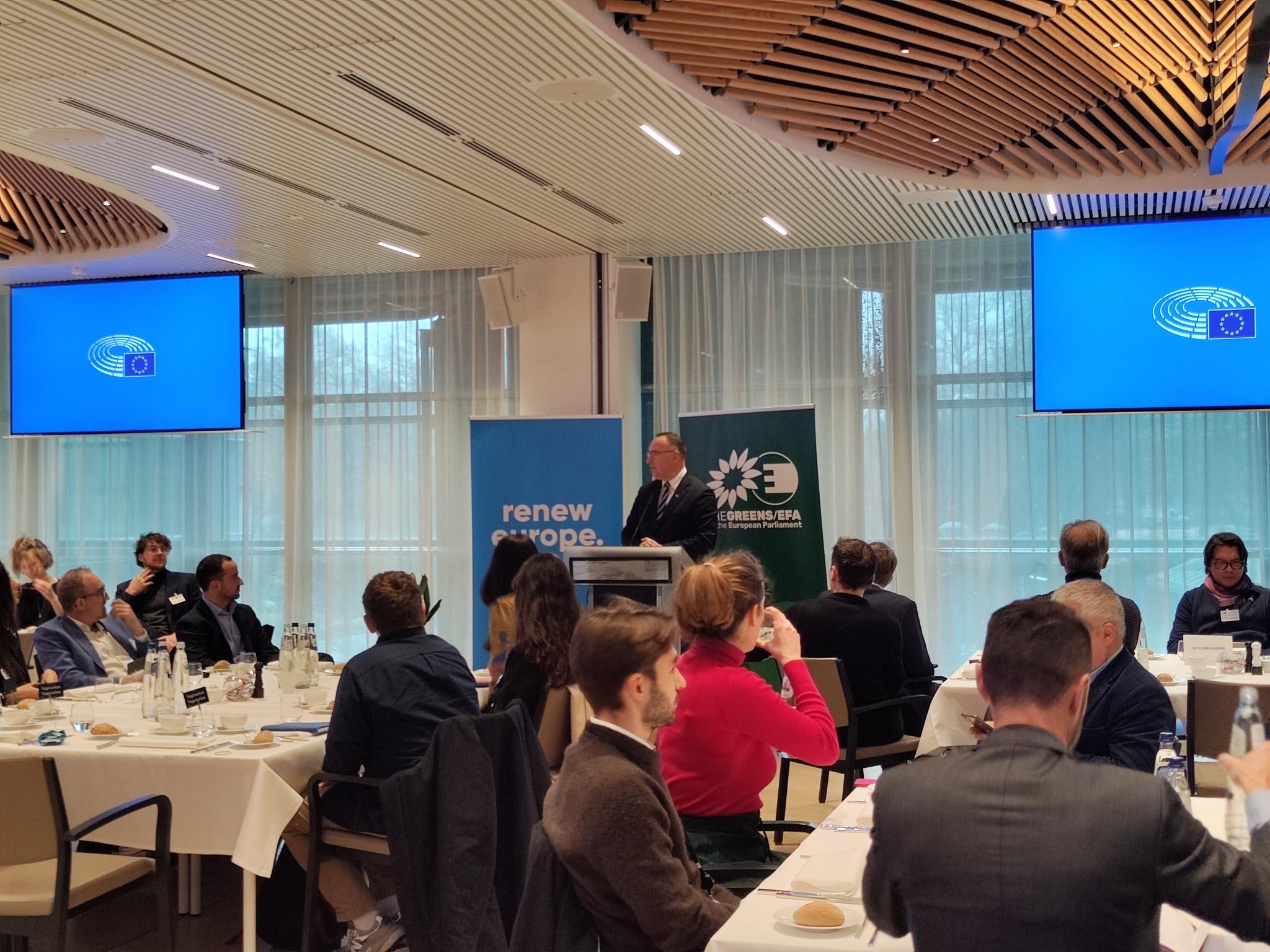
Key Notes and Policymaker Insights
MEP Michał Kobosko opened the meeting by positioning the theme of public AI within broader debates on digital sovereignty. As policy debate addressed various layers of the European digital stack, the discussion on AI was often limited to criticism of the AI Act. According to Kobosko, more attention in debates on Europe’s sovereignty needs to be focused on the issue of European open source AI development, and on building public AI solutions.
Felix Sieker (reframe[Tech] project, Bertelsmann Stiftung) presented our joint policy brief, which describes public AI as an approach based on universal access, mission-driven public goals, and public control. The brief examines the AI Continent Action Plan and the Apply AI strategy and, in this context, makes the following recommendations:
- Orienting investments in computing power towards public AI objectives;
- Deploying European open source foundation models, based on a demand-driven strategy; and
- Data for AI strategy based on ensuring legal certainty for using publicly available data and sharing of high-value datasets.
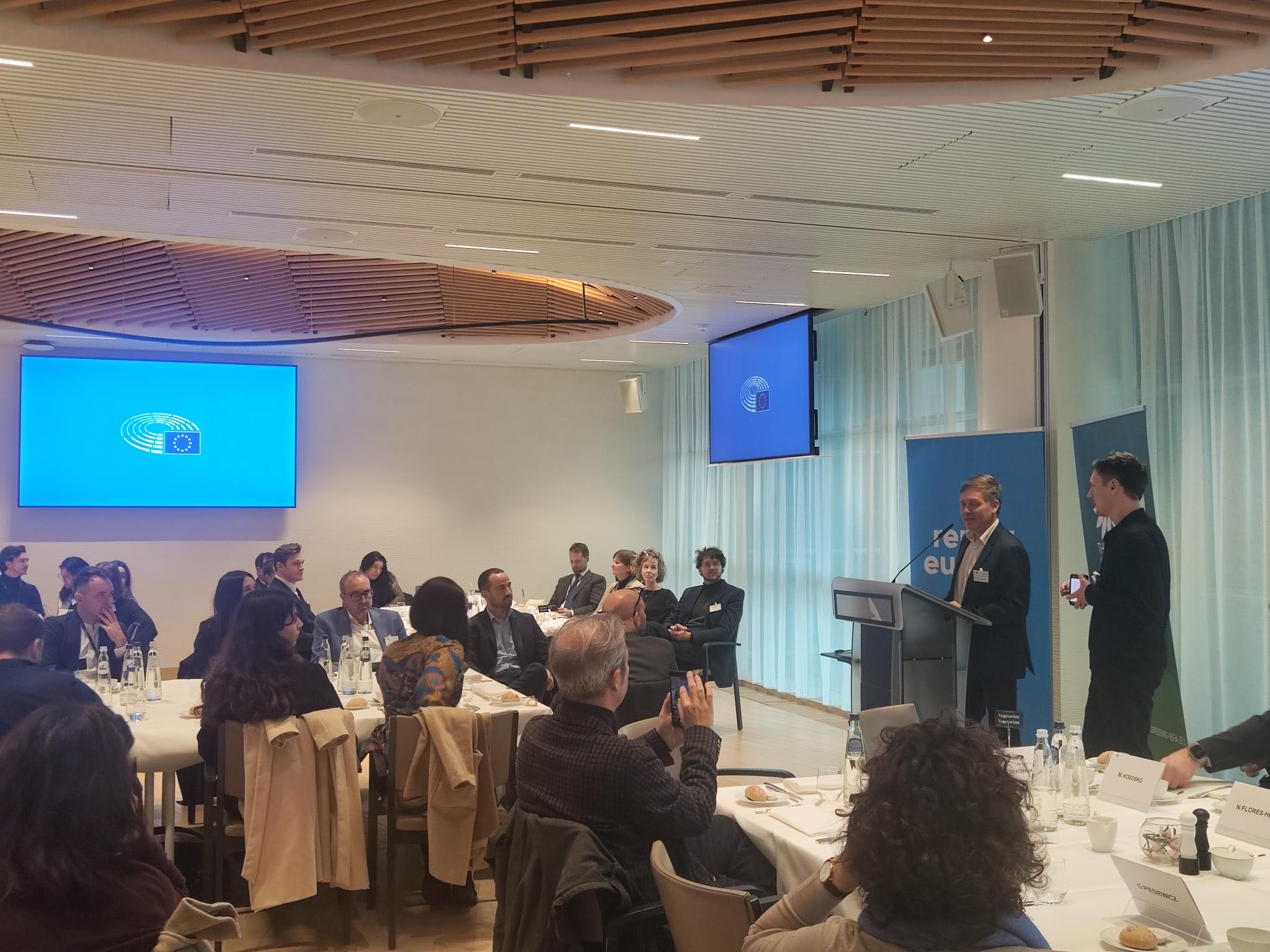
A showcase of European public AI
In the first part of the meeting, European AI builders presented their work and recommendations on how to strengthen the public AI ecosystem. Nicolas Flores-Herr (Fraunhofer Institute) talked about the importance of creating ecological, trustworthy, and competitive European foundation models. In order to do that, Europe needs to create systemic paths from research to scalable model production and deployment.
Albert Cañigueral (Barcelona Supercomputing Center) showed how a public research institution can combine public compute provided through an AI Factory, model development, and research talent. This creates capacity for sustained effort and has already resulted in ALIA, a family of Spanish and co-official language models. He highlighted the importance of thinking of AI as a public utility and providing legal certainty around AI development and commercial usage.
Ivan Yamshchikov (Pleias) talked about his company’s mission to build models that are data efficient and also state of the art. Startups like Pleias, in order to thrive, require access to capital, the scale of a single European market, and mechanisms that reward risk-taking.
Finally, Antoine Isaac (Europeana Foundation) explained how cultural institutions can contribute to AI development with heritage resources: structured, curated content that can help reduce bias and enrich AI model output. He proposed a data lifecycle, where data spaces like Europeana collaborate with AI Factories and data labs.
Grażyna Piesiewicz (Head of Unit for High Performance Computing and Applications, DG CONNECT) responded to these presentations and stated that Europe is aiming to move beyond an “AI race” approach, where AI is a self-justifying solution. Instead, the path taken by European policymakers treats these technologies as essential infrastructure, and adopts a full stack approach to their development and deployment. She used the example of Destination Earth, a €500+ million initiative building a climate model for Earth. The project achieved cutting-edge performance while remaining open, transparent, and sovereign. She listed building a common market, reducing regulatory fragmentation, and retaining AI talent as main challenges that need to be addressed.
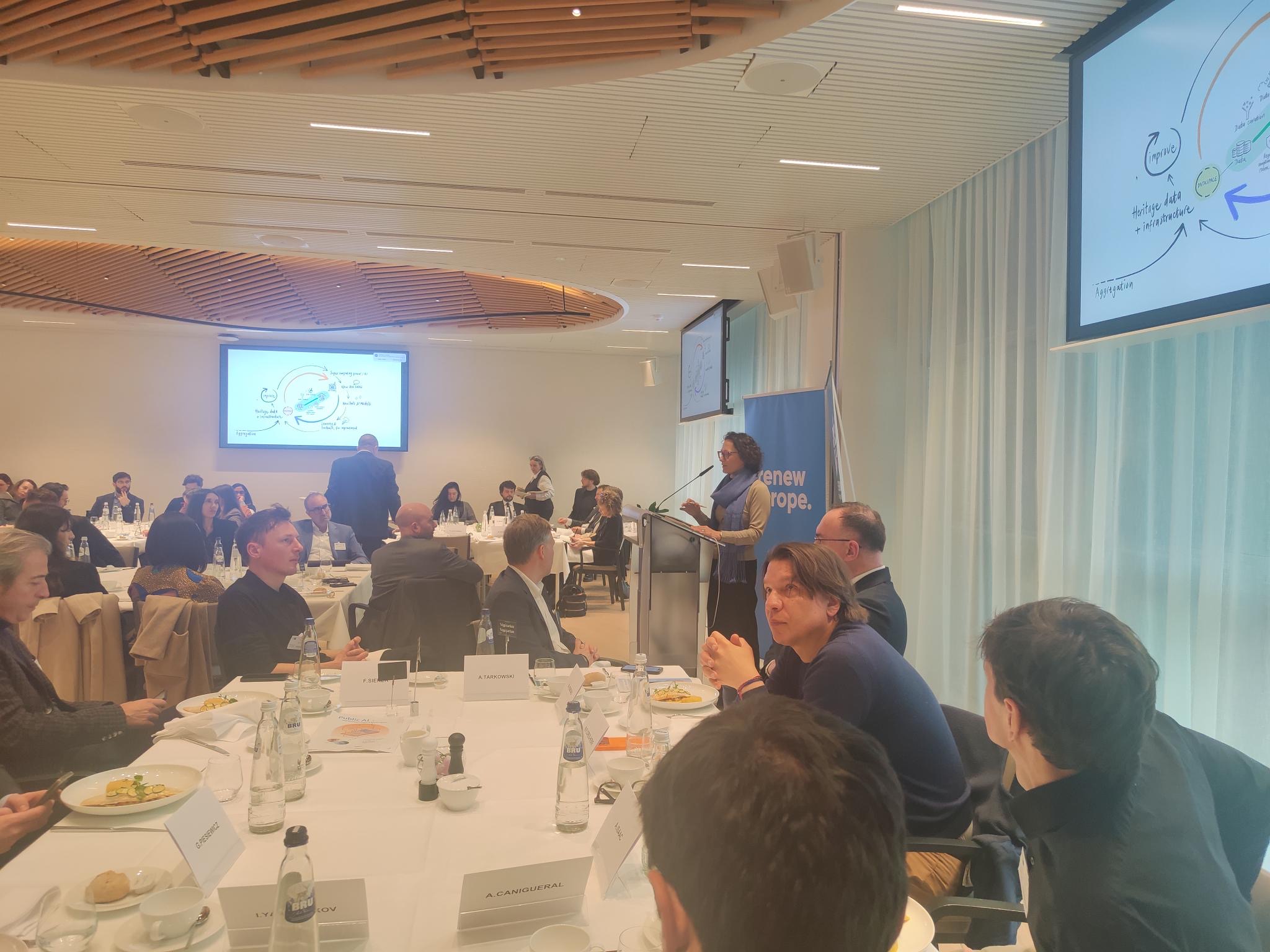
What is needed to build European public AI solutions?
Maximilian Gahntz (Mozilla) introduced the second discussion panel by stating that the EU will not succeed by copying the strategies of the dominant actors, only in an ecosystem with fewer resources. Instead, the EU needs to find ways for strategic differentiation, by carving out a special niche for Europe in the global AI ecosystem.
MEP Brando Benifei talked about the importance of AI Factories and Gigafactories and about aligning these sources of compute with the public AI approach. This is also a matter of ensuring that the new European multiannual budget prioritises technologies that serve common needs of European citizens. He described public AI policies as a continuation of a vision of democratic and human-centered AI that underpinned the Parliament’s position on the AI Act.
Raegan MacDonald (AspirationTech) argued that public AI policy needs to be based on a vision of redistributing power, respecting planetary boundaries, and delivering public benefit. To this end, it is not enough to open source AI technologies–this needs to go hand in hand with ensuring greater participation of various communities in AI development, and lowering barriers to entry. Public AI will mean very little if the communities cannot challenge decisions or shape how technologies are deployed.
Malgorzata Nikowska (Head of Unit for Artificial Intelligence Innovation and Policy Coordination, DG CONNECT) noted that Europe’s AI Action Plan offers an original pathway for AI development. It is meant to tap into Europe’s competitive advantages like a vibrant startup ecosystem, strong and skilled engineering and research and ongoing work to secure compute capacity through AI Factories and Gigafactories.
Sebastiano Toffaletti (Digital SME Alliance) described a rush to adopt AI solutions, driven largely by the interests of the dominant AI companies. Yet the fear of missing out is not justified, and European companies do not need to immediately purchase available AI services. Instead, they should use open source AI models to build their own, independent solutions. He recommended SMEs use open source models on their own servers to maintain data ownership and avoid cloud dependencies.
Next Steps and Resources
MEP Sergey Lagodinsky, in his closing remarks, emphasized creating business cases for democratic technologies: not just regulating European markets, but creating and selling solutions that can shape the AI ecosystem at global scale. These business solutions would embed European values, our approach to risk mitigation, and our vision of regulating technologies. He proposed three policy directions: earmarking EU budget funds for public AI, reforming the EIC Accelerator and Horizon Europe into a sovereign wealth fund that can steer technological development, and positioning the EU as a geopolitical technology investor.
Alek Tarkowski outlined three priorities for the coalition of organizations advocating for European public AI: advocacy work on financial policy, with a focus on the Multiannual Financial Framework, strengthening the European open source AI ecosystem and advocating for shared work on public frontier AI models, and advancing a model of AI development that is demand-driven and focused on needs of European citizens and communities.
The European Public AI policy brief, co-produced by Open Future and Bertelsmann Stiftung, offers concrete recommendations for the AI Continent Action Plan.


