Divergent Mechanisms Elusive Vocabularies
This policy brief reviews the state of machine-readable rights reservations, TDM opt-outs, and AI preference signaling at the end of 2025. Building on our March 2025 policy brief proposing A Vocabulary for Opting Out from AI Training and Other Forms of TDM, it examines how approaches to signaling and interpreting such preferences have evolved over the past year.
It takes a high-level view of emerging preference-signaling mechanisms and standards, focusing on the vocabularies used to describe and differentiate between specific types of uses of protected works and other content. It also situates these developments in the context of the European Commission’s consultation on protocols for reserving rights from text and data mining.
The brief is organized in three parts, beginning with an overview of key developments over the past year, followed by an analysis of existing approaches to defining opt-out and preference vocabularies and the relationships between them. It concludes with a discussion of the challenges these developments raise and the design principles that should guide the development of a shared vocabulary layer.
Key findings
Based on the comparative analysis of existing opt-out and AI preference vocabularies presented in Part 2, the brief identifies several key developments and structural challenges:
- Fragmentation and instability: Several opt-out solutions identified in early 2025 are no longer available, while new approaches have emerged that were not anticipated at the start of the year.
- Vocabulary divergence: Analysis of existing vocabularies reveals limited overlap in how different initiatives define and categorize AI-related uses, with particular disagreement around the role of overarching categories and the representation of inference- and deployment-time uses.
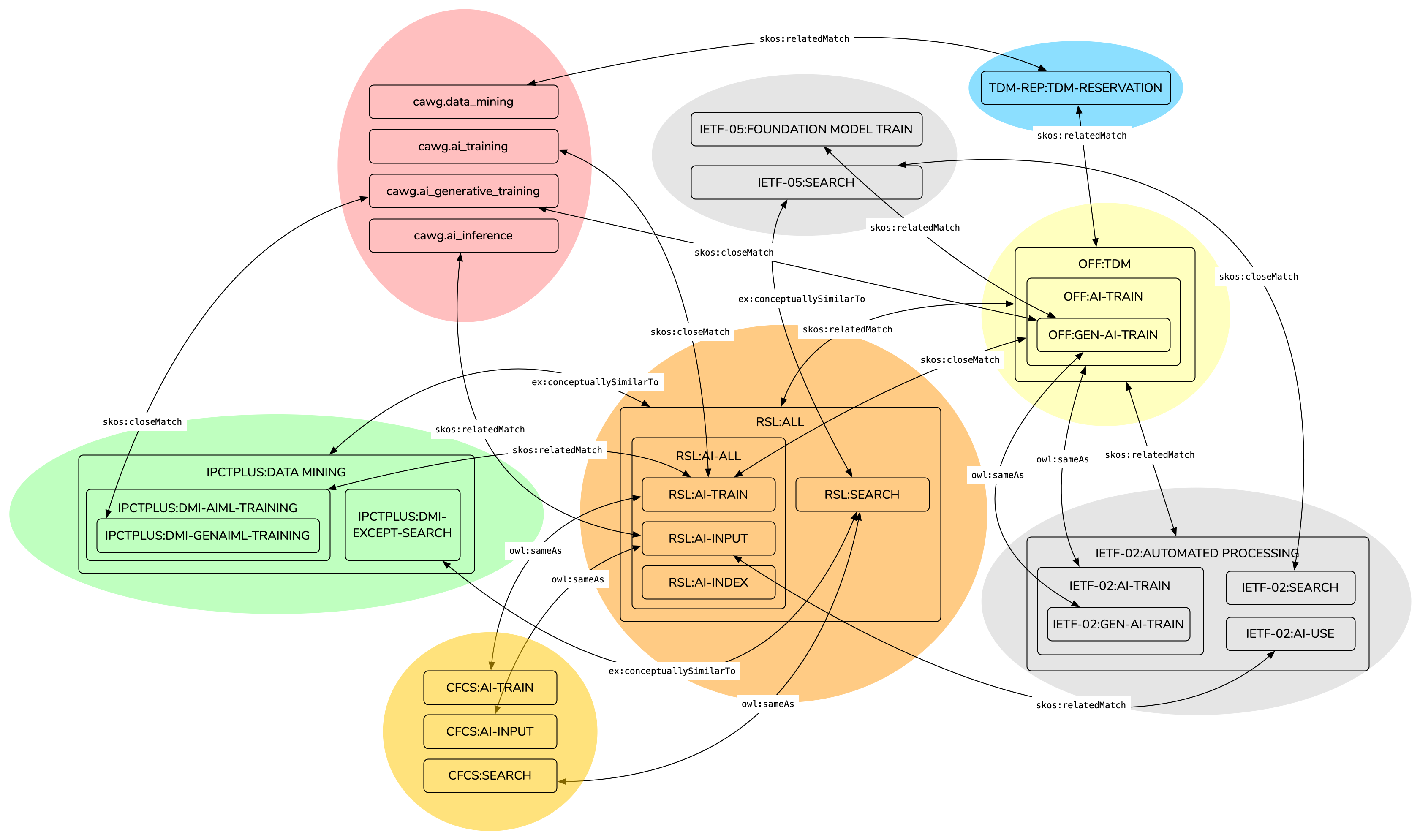
- Governance concerns: The most comprehensive vocabulary (RSL) has been developed outside formal standards bodies by a relatively narrow set of stakeholders, while the open, multi-stakeholder IETF process has struggled to make progress.
- Risk of imbalance: Current approaches tend to focus heavily on publisher and rightsholders’ interests while making little reference to user rights, limitations and exceptions to copyright, or the need to balance competing interests.
Design principles for a common vocabulary
Against this background, the brief identifies four design principles that emerge from the analysis and that are intended to inform the development of a shared vocabulary layer:
- Legal minimalism: Vocabularies should operate within existing legal frameworks rather than restate, reinterpret, or expand them.
- Explicit acknowledgment of limits and exceptions: Expressed preferences must operate within legal limits, including copyright exceptions and other user rights.
- Separation of signaling and enforcement: The vocabulary layer should remain distinct from mechanisms for technical enforcement or contractual licensing.
- Interoperability before completeness: A smaller set of well-defined, widely understood terms that can be mapped across systems is more valuable than a comprehensive but idiosyncratic taxonomy.
By articulating these principles and analyzing the current state of the vocabulary landscape, the brief contributes to more informed policy decisions and supports the development of a shared vocabulary layer that functions as genuine semantic infrastructure—enabling coordination across diverse technical and legal approaches while remaining neutral with respect to enforcement models, commercial arrangements, and regulatory compliance strategies.